About MEES
A guide to the Minimum Energy Efficiency Standards for leased commercial property
What is MEES?
The Minimum Energy Efficiency Standards (MEES) set legal thresholds for the energy performance of leased commercial buildings. Landlords must not grant a new lease or continue to let a property that falls below the minimum Energy Performance Certificate (EPC) rating at key deadlines.
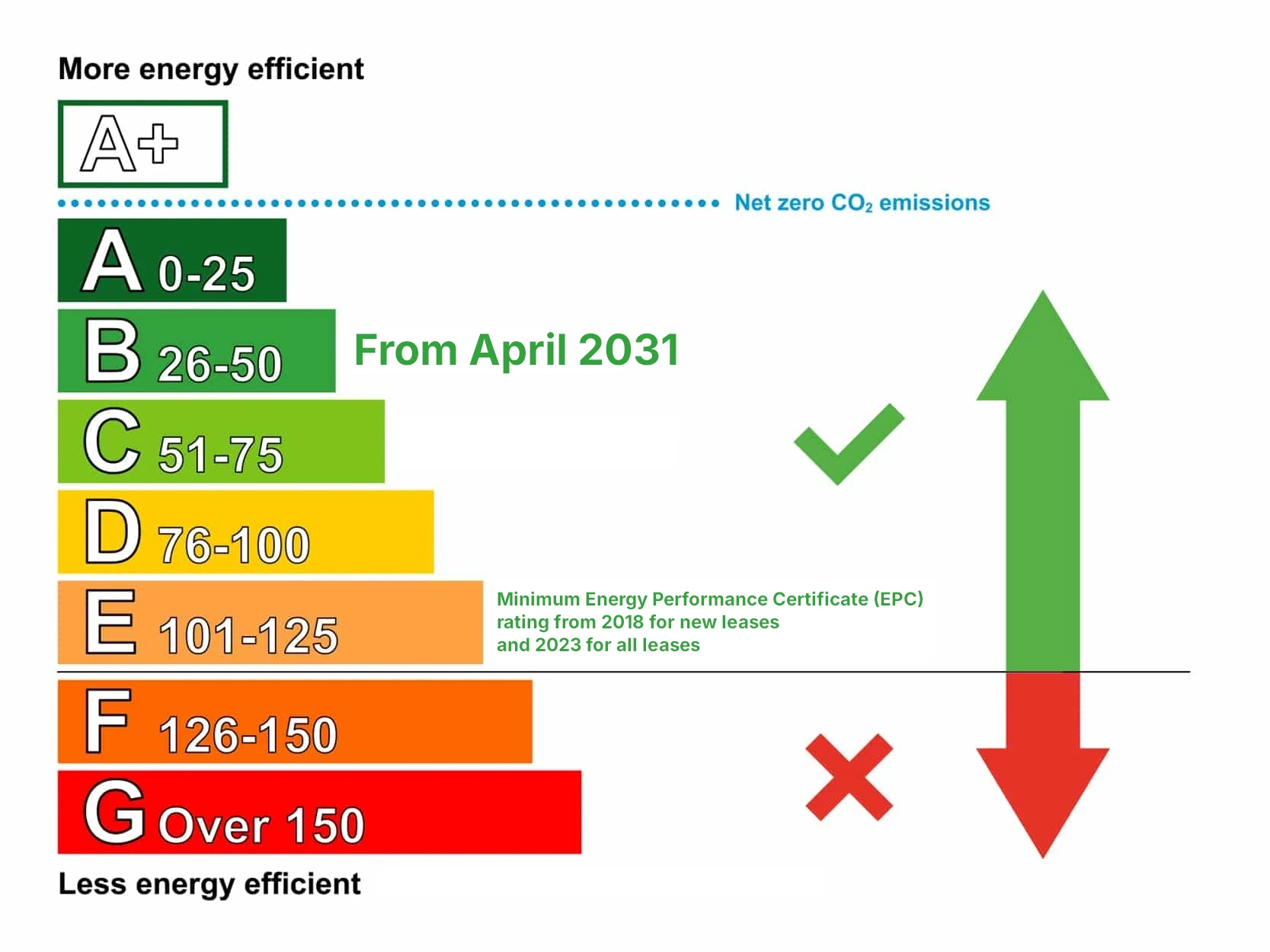
MEES currently applies in England and Wales, although there are consultations ongoing about extending it to Scotland. Today, it’s unlawful to let properties rated F or G unless a valid exemption applies. The Government has now confirmed a revised proposed direction for future non-domestic MEES, focused on larger privately rented buildings, so planning ahead remains essential.
MEES overview
The Minimum Energy Efficiency Standards (MEES) are regulations designed to improve the energy performance of rented buildings. For non-domestic property, the rule that took effect in 2018 was extended in 2023: landlords may not grant or continue a letting of a sub-standard property (EPC band F or G) unless a valid exemption is registered.
In brief
- 2018: New lettings and renewals required to be EPC E or better
- 2023: Continuing to let F or G rated properties unlawful
- 2031: Private rented non-domestic buildings over 1,000 square metres to reach EPC B
- Below 1,000m²: Buildings are expected to remain subject to the current EPC E minimum standard
- Penalties scale with rateable value, up to £150,000 per breach
Last updated: June 2026
Key dates and what they mean
A plain-English timeline for commercial landlords and their advisors.

1 April 2018
It became unlawful to grant a new lease, or renew one, on any F or G-rated property unless a valid exemption was in place.
1 April 2023
It is currently unlawful to continue to let any F or G-rated property, regardless of the lease start date, unless it is exempt.

2027/28 milestone
The previously proposed interim EPC C milestone is no longer being taken forward under the Government’s revised approach.

1 April 2031
Privately rented non-domestic buildings over 1,000 square metres in England and Wales are proposed to require an EPC rating of B.
Why MEES matters
Non-compliance with the Minimum Energy Efficiency Standards can have serious financial and commercial consequences. These may include:
- Civil penalties: Fines scale in line with the property’s rateable value, with extended breaches attracting penalties up to £150,000 per property.
- Publication of penalties: Details of any breach are listed on a public register, which impacts reputation and demonstration of Corporate Social Responsibility.
- Restricted income: You are likely to be unable to let a property (or parts of it) until remedial works are complete or exemptions are in place.
- Asset & finance impacts: You may face downgraded valuations and potential void periods. Lenders are unlikely to offer any form of refinancing.
How we help to reduce your risk
- An independent non-domestic EPC gives us a baseline and we then perform comprehensive data validation.
- Our structured MEES Compliance Report contains comprehensive scenario modelling aligned with current and proposed future requirements.
- We provide detailed capital expenditure and payback forecasts, including the 7-year payback test.
- We introduce various funding routes to assist remedial works and reduce payback time.
- Our framework contracting solutions provide verifiable routes to delivery in line with the PAS 2038 standard.

Exemptions & when they apply
Some properties can’t practically or cost-effectively reach the minimum standard. In those cases, a time-limited exemption may be available.
Common exemption types
- 7-year payback test: If savings over 7 years don’t cover the cost of works.
- All improvements made: You’ve implemented all relevant measures, but rating remains below the minimum.
- Third-party consent: Consent (e.g., freeholder or planning permissions) refused or granted with unreasonable conditions.
- Devaluation: A qualified surveyor evidences that improvement measures would significantly reduce the property’s value.
- Wall insulation: Specific cases where insulation would damage fabric or isn’t appropriate and a rating cannot be achieved without it.
- New landlord: Limited-duration exemption may apply in certain defined transfer scenarios.
Scope & special cases
- MEES generally only applies where an EPC is legally required. If no EPC is required, the rules may not apply.
- Listed buildings and those in conservation areas: These often require an EPC, but exemptions may apply if compliant works would unacceptably alter the character of the building.
- Exemptions are not permanent: most last up to 5 years and must be registered with significant supporting evidence.
- Very short or very long leases: MEES does not apply to lettings of 6 months or less (without renewal rights) or to leases of 99 years or more.
We can verify eligibility, compile evidence, and handle registration on the PRS Exemptions Register where appropriate.
MEES FAQs
Some short answers to our most frequently asked questions. For specific scenarios, please contact us to speak to our team.
Practical considerations
- Portfolio triage: We can help you to identify higher-risk assets, lease events, and buildings likely to fall short of future MEES requirements.
- Planning remedial works: It’s often more cost-effective to plan for B once, rather than upgrading twice.
- Occupier disruption: We can assist you to coordinate with tenants and to schedule invasive works alongside lease events.
- Capex & payback: We use robust cost models and sensitivity analysis (energy prices, finance costs) to reduce payback periods.
- Exemptions strategy: Where justified, we can register exemptions correctly with supporting evidence and forward-plan for their expiry.
Our MEES Compliance Reports
A data-driven report that validates your EPC baseline, models upgrade scenarios, projects ROI, and sets out a compliant, cost-effective roadmap.
- Validated EPC baseline & building data
- Multiple improvement scenarios aligned with current and proposed future MEES requirements
- Capex, payback & operating cost projections
- Funding routes and PAS 2038-aligned delivery